

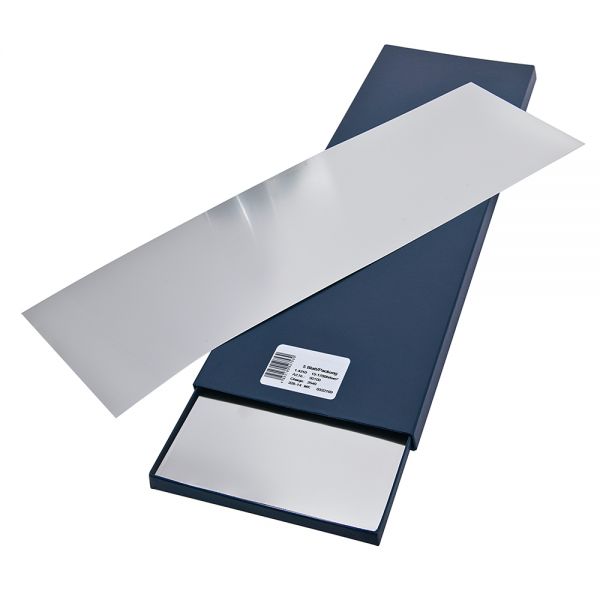
Spring steel CK101 - 500 x 150 mm - (5 pieces/PU)
| Quantity | Unit price | Base price |
|---|---|---|
| To 2 |
€39.40
|
€105.07 / 1 m² |
| To 4 |
€37.43
€39.40
(5% saved)
|
€99.81 / 1 m² |
| From 5 |
€35.46
€39.40
(10% saved)
|
€94.56 / 1 m² |
available, ready to ship in 1-2 days
Notice: 5 pieces / PU
Info: Special discount on larger quantities!
Technical Information - hardened Spring Steel 1095
Basic information and applications 1095
With a carbon content of over 1%, this material is very well suited for feeler gauges and underlay foils as well as for highly stressed springs, which are not subject to any corrosion requirements.
Further areas of application are wear strips, pressure knives & valves in shock absorbers.
In DIN EN 10 132-4 the 1095 is approved as a material for springs.
Compared to the materials 1.1231 (C67S), 1.1248 (C75S) and 1.1269 (C85S), which have a lower carbon content, the material 1095 is also suitable for high mechanical loads and has a high fatigue strength. It is the only carbon steel used for shock absorber valves and leaf valves.
If there is a risk of corrosion and the highest mechanical stress requirements, we recommend material 1.4031.
Delivery condition
Structure: hardened and tempered (martensitic structure)
Surface: white polished, roughness class Ra (please ask)
Tensile strength: depending on the thickness from 1600-1800 to 2000-2200 N / mm²
Flatness: usually P2=0,3% of the bandwidth
Tolerances
Thickness tolerance: T3
Width tolerance: B2
Straightness: normal
mechanical Details
Elongation limit Rp0.2: about 90% of the tensile strength
Elongation A80: no values available
Fatigue limit: high fatigue limit, suitable for shock absorbers or leaf valves
With good edge processing after cutting (e.g. by surface grinding) the following values can be achieved:
Alternating bending stress (medium stress = 0): 620-680 MPa with a fracture probability of 5%
Tension threshold stress (minimum stress = 0): 520-580 MPa with a fracture probability of 5%
No values can be guaranteed as the fatigue strength depends on various factors such as the ambient conditions and the edge properties.
Please ask if the material in stock is suitable for use as leaf valve steel or shock absorber steel.
In the case of very high loads or use of a corrosive environment, we recommend the stainless hardened special steel 1.4031Mo.
The highest application temperature should not exceed 200 ° C. Please note that the elastic modulus values decrease with increasing temperature.
At higher temperatures up to about 350 ° C we recommend the use of stainless hardened steels, materials 1.4031Mo and 1.4034.
At even higher temperatures, alloy 718 must be used (a precipitation hardenable nickel alloy), which can be used up to approx. 650°C (precipitation hardenable nickel alloy), which can be used up to approx. 650°C.
Alloy designations
| German Norm: | 1.1274 C100S+QT (Ck101) |
| AISI: | 1095 |
| ASTM: | G 10950 |
| Engl. Norm: | 95 (B.S. 5770 Part 1) |
| Franz. Norm: | XC 100 |
| Japan. Norm: | SK 4 - CSP (Norm G4802) |
Material - Composition*
| C: | max. 0,95 - 1,05 % |
|
Si: |
0,15 - 0,35 % |
| Mn: | 0,30-0,60 % |
| P: | max. 0,025 % |
| S: | max. 0,025 % |
| Cr: | max. 0,40 % |
| Ni: | max. 0,40 % |
| Mo: | max. 0,10 % |
* for the exact composition can be documented in the form of a work certificate 3.1 (according to DIN 10 204) for each batch.
Physical information
| Density: | 7,9 g/cm³ |
| Heat conduction: | 49 W/(m °C) at 20°C |
| Heat capacity: | 460 J / (Kg ° C) average values at 50 - 100 ° C |
| Thermal expansion: |
10,5x10 -6 (between 30 - 100 °C) 11,5x10 -6 (between 30 - 200 °C) 12,5x10 -6 (between 30 - 300 °C) |
| Electrical resistance: | about 0.20 Ohm x mm² / m (hardened for 1.1231) |
| Modulus of elasticity: | 210 000 MPa at 20°C |
| Relative permeability µr: | ca. 400 (hardened for material 1.1231 = C67S) |
Processing information 1095
Punching: The cutting gap should correspond to approximately 10% of the strip thickness. The corner radii should be at least 0.25 and the punch diameter at least twice the tape thickness. After punching, the parts can be heat-treated to relieve stress, at a maximum temperature of 250 ° C and for a duration of approx. 30 - 60 minutes.
For stamped parts, post-treatment by slide grinding is necessary to achieve good fatigue strength.
Instead of punching, the parts should be etched.
Laser cutting: Melting the steel at the cutting edge can lead to locally higher hardness and thus reduced toughness at the cutting edge. A cut with a water jet is recommended for critical parts.
Etching: The material is very easy to etch.
Bending: The strip structure is changed by the hardening process. This means that the direction of rolling when edging does not have to be observed. Bending radius: at least 10 times the strip thickness.
Springback: Since springback depends on various factors, bending tests should be carried out. An angle of 10 ° with a strip thickness of 0.20 mm and an angle of 20 ° with a strip thickness of 0.60 mm can be taken as a reference point.
Surface grinding: The material 1095can be magnetized and can therefore be clamped on magnetic chucks of grinding machines.
Welding: Due to the high carbon content of around 1%, material 1095 should not be welded.
Chemical resistance 1095
The unalloyed steels must be estimated from corrosion by an oil film. Tinning or galvanizing or painting these steels can withstand corrosion permanently.
Important NOTE
The technical information listed above or the information provided on the nature or use of the materials serve for description and are not a guarantee of properties. The information with which we want to advise you corresponds to our experience and that of our upstream suppliers. We cannot guarantee the results of processing and application. (03/2024)
Bronze Foil - Bronze Sheet Bronze is an alloy of copper (Cu) and tin (Sn). A distinction is made between wrought and cast alloys depending on the processing. Typical application examples are connectors, contact pins, as well as general stamped and bent parts and springs, where good electrical conductivity is necessary In contrast to brass, bronze can also be used in vacuum technology. Properties material CW452K - 2.1020 The bronze alloy CW452K - also called two-alloy - is the most frequently used type of bronze with a tin content of approx. 6%. The alloy CW452K is characterized by a particularly favorable combination of cold formability, strength and hardness. In addition, bronze is very corrosion and wear-resistant as well as seawater-resistant and has good tinnability. Technical information Bronze cannot be magnetized and therefore cannot be clamped on grinding machines. Bronze plates can be laser cut well and are very easy to etch. CuSn6 is easy to weld with all processes. However, the heat input at the weld seam can lead to a structural change that reduces the strength. Bronze is very suitable for soft soldering. The high strength of the bronze plates or the material is achieved by cold forming during rolling. Therefore, the direction of rolling has a great influence on bending. Other applications / properties:
Content: 0.375 m² (€132.40 / 1 m²)
Bronze Foil - Bronze Sheet Bronze is an alloy of copper (Cu) and tin (Sn). A distinction is made between wrought and cast alloys depending on the processing. Typical application examples are connectors, contact pins, as well as general stamped and bent parts and springs, where good electrical conductivity is necessary In contrast to brass, bronze can also be used in vacuum technology. Properties material CW452K - 2.1020 The bronze alloy CW452K - also called two-alloy - is the most frequently used type of bronze with a tin content of approx. 6%. The alloy CW452K is characterized by a particularly favorable combination of cold formability, strength and hardness. In addition, bronze is very corrosion and wear-resistant as well as seawater-resistant and has good tinnability. Technical information Bronze cannot be magnetized and therefore cannot be clamped on grinding machines. Bronze plates can be laser cut well and are very easy to etch. CuSn6 is easy to weld with all processes. However, the heat input at the weld seam can lead to a structural change that reduces the strength. Bronze is very suitable for soft soldering. The high strength of the bronze plates or the material is achieved by cold forming during rolling. Therefore, the direction of rolling has a great influence on bending. Other applications / properties: good corrosion resistance easy to solder easy to polish good cold formability good spring properties Use: springs of all kinds, metal hoses, etc. Application: paper, pulp, textile and chemical industry as well as in ship, machine and apparatus construction, tombstones
Content: 5 Meter (€19.06 / 1 Meter)
Bronze Foil - Bronze Sheet Bronze is an alloy of copper (Cu) and tin (Sn). A distinction is made between wrought and cast alloys depending on the processing. Typical application examples are connectors, contact pins, as well as general stamped and bent parts and springs, where good electrical conductivity is necessary In contrast to brass, bronze can also be used in vacuum technology. Properties material CW452K - 2.1020 The bronze alloy CW452K - also called two-alloy - is the most frequently used type of bronze with a tin content of approx. 6%. The alloy CW452K is characterized by a particularly favorable combination of cold formability, strength and hardness. In addition, bronze is very corrosion and wear-resistant as well as seawater-resistant and has good tinnability. Technical information Bronze cannot be magnetized and therefore cannot be clamped on grinding machines. Bronze plates can be laser cut well and are very easy to etch. CuSn6 is easy to weld with all processes. However, the heat input at the weld seam can lead to a structural change that reduces the strength. Bronze is very suitable for soft soldering. The high strength of the bronze plates or the material is achieved by cold forming during rolling. Therefore, the direction of rolling has a great influence on bending. Other applications / properties:
Content: 0.075 m² (€198.53 / 1 m²)
Product information "Spring steel CK101 - 500 x 150 mm - (5 pieces/PU)"
Sheet - Foil of Carbon steel (C- Steel)
Precision sheets / underlay made of carbon steel 1095 (C100S) - 1.1274 are used among others in mechanical engineering as underlay foils, for aligning workpieces in grinding machines or for setting and measuring gap dimensions.
Properties material 1.1274
With a carbon content of over 1%, this material is very well suited for feeler gauges and underlay foils as well as for highly stressed springs, which are not subject to any corrosion requirements.
Compared to the materials 1.1231 (C67S), 1.1248 (C75S) and 1.1269 (C85S), which have a lower carbon content, the material 1.1274 is also suitable for high mechanical loads and has a high fatigue strength.
Technical information
The thickness tolerance is defined according to DIN EN 9445 table 1 or T3.
The material 1.1274 is magnetizable and can therefore be clamped on magnetic chucks of grinding machines.
The structure of the strip is changed by the hardening process. This means that the rolling direction does not have to be taken into account when edging. Bending radius: at least 10 times the strip thickness.
The unalloyed steels must be estimated from corrosion by an oil film. Tinning or galvanizing or painting these steels can withstand corrosion permanently.
Further applications / properties:
- Wear strips
- Printing racks
- very easy to etch
- magnetizable
| Alloy: | Ck101 |
|---|---|
| DIN Material - Name: | C100S+QT |
| Delivery - State: | hard |
| Length: | 500 mm |
| Magnetisable: | yes |
| Material - Number: | 1.1274 |
| Structure: | gehärtet und angelassen (martensitisches Gefüge) |
| Surface: | white polished |
| Tensile Strenght: | 16-1800 N/mm², 16-1900 N/mm², 18-2000 N/mm², >2000 N/mm² |
| Thickness Tolerance: | T3 |
| Width: | 150 mm |
| Material: | Carbon Steel |
| ASTM/AISI (USA): | 1095 |
| Norm: | DIN 10204 |
Uferstraße 44
93158 Teublitz
Germany
Uferstraße 44
93158 Teublitz
Germany
Login