

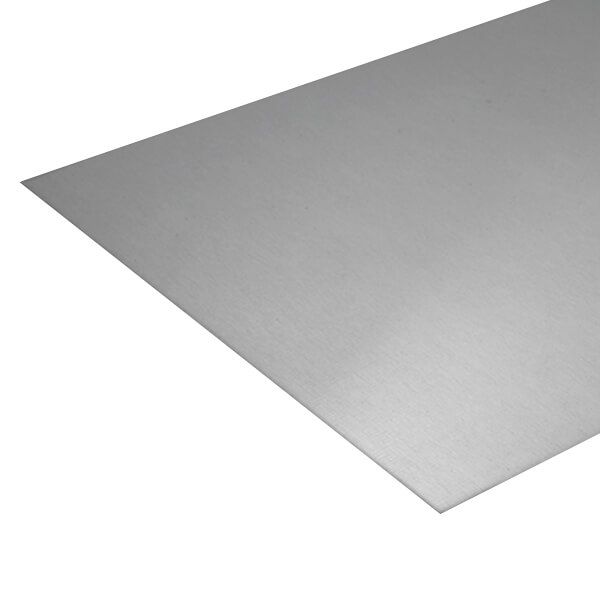
Steel Sheet (1.0338) 500 x 150 mm
| Quantity | Unit price | Base price |
|---|---|---|
| To 2 |
€9.45
|
€126.00 / 1 m² |
| To 4 |
€8.98
€9.45
(4.97% saved)
|
€119.73 / 1 m² |
| To 9 |
€8.51
€9.45
(9.95% saved)
|
€113.47 / 1 m² |
| From 10 |
€7.56
€9.45
(20% saved)
|
€100.80 / 1 m² |
available, ready to ship in 1-2 days
Notice: 1 pieces / PU
Info: Special discount on larger quantities!
Technical Information - unalloyed steel DC04 - 1008
Basic Information and Applications DC04 - 1008
Unalloyed steels are very inexpensive materials for simple parts without any demands on corrosion resistance or mechanical loads.
Depending on the area of application, the unalloyed steels DC01 to DC05 are available in different strength classes from annealed to hard-rolled versions.
With a tensile strength of at least 490 N / mm² (+ C490), quality in stock can be punched well, but only partially formed or deep-drawn.
For formed parts, the 1008 should therefore be used in a softer version such as + LC with tensile strengths of 270 - 350 N / mm²; for demanding deep-drawn parts such as spare wheel wells, the grades DC06 or DC07 should be used.,
Further application examples: Body panels, furniture fittings, painted sheet metal cladding
Unalloyed steels are not permitted as spring materials. Hardened carbon steels such as C75S (1.1248) or C100S (1.1274) should be used for springs.
Delivery condition
Structure: cold-rolled, not hardenable
Surface: MA (bare metal)
Tensile strength: > 590 N / mm² (for some strengths > 490 N/mm²)
Tolerances
Thickness tolerance: DIN EN 10140
Width tolerance: according to DIN EN 10140
Straightness: normal
Flatness: wave height max. 1.0 mm
The tolerances are specified in the standards EN10130 and 10140.
mechanical information:
Yield strength Rp0.2: depends on the tensile strength
Elongation A80: depends on the tensile strength
No information on flexural fatigue strength is available. However, the unalloyed steels should not be used for mechanically stressed parts.
Depending on the load, the highest application temperature is around 200° Celsius.
Please note that the values for the modulus of elasticity decrease with increasing temperature.
Alloy Designations
| German Norm: | 1.0338 DC04 (formerly St2 K50) |
| ASTM: | A 620 (1008) |
| Engl. Norm: | BS 1449 1 CR |
| AFNOR: | ES |
| Japan. Norm: | SPCE, HR4 |
Physical Information
| Density: | 7,86 g/cm³ |
| Heat conduction: | 45 - 55 W/(m °C) depending on the temperature |
| Heat capacity: | 460 J / (kg ° C) mean value at 50 - 100 ° C |
| Thermal expansion: |
12 x 10 -6 (between 30 - 100 °C) |
| Electrical resistance: | 0,13 Ohm x mm²/m |
| Modulus of elasticity: | 210 000 MPa at 20°C |
| Relative permeability µr: | approx. 2000 |
Material - Composition *
| C: | max. 0,08 % |
| Mn: | max. 0,40 % |
| P: | max. 0,03 % |
| S: | max. 0,03 % |
*The composition is specified in the EN 10130 standard. The exact composition can be documented for each batch in the form of a factory certificate 3.1 (according to DIN 10 204).
Processing information DC04 - 1008
Punching: The cutting gap should correspond to about 4 - 10% of the tape thickness.
The corner radii should be at least 0.25 and the punch diameter at least twice the tape thickness.
Post-treatment by vibratory grinding is necessary for stamped parts to achieve good fatigue strength.
Laser cutting: This material can be laser cut very well.
Etching: The material can be etched very well.
Bending: Since the high strength of the material is achieved through cold deformation during rolling, the rolling direction has a great influence on bending.
The recommended minimum bending radius also depends on the tensile strength.
Bending transversely (perpendicular) to the rolling direction:
Minimum bending radius = 2x strip thickness
Bending along (parallel) to the rolling direction:
Minimum bending radius = 6x strip thickness
We recommend the use of strength class LC (annealed, lightly re-rolled) for bent parts and grades DC06 and DC07 for demanding deep-drawn parts such as spare wheel wells in passenger cars.
Surface grinding: The unalloyed steels are easy to magnetize and can be clamped very well on magnetic chucks of surface grinding machines.
Welding: Like other unalloyed steels, the material is very easy to weld.
Chemical Resistance DC04 - 1008
The unalloyed steels are not corrosion-resistant and must be protected against corrosion by galvanizing, tin-plating, chrome-plating or painting.
Important NOTE
The technical information listed above or the information provided on the nature or use of the materials serve for description and are not a guarantee of properties. The information with which we want to advise you corresponds to our experience and that of our upstream suppliers. We cannot guarantee the results of processing and application. (03/2024)
Non-alloyed steels are very low-cost materials for simple parts with no demands on corrosion resistance and mechanical loads. As a rule, this special grade (DC04) is used, for example, for simple automotive parts both indoors and outdoors. The material DC 04 is magnetizable and can therefore be clamped very well on magnetic clamping plates of surface grinding machines. This steel is not corrosion resistant and must be protected against corrosion by galvanizing, tinning, chrome plating or painting. Further Applications / Properties: body panels furniture fittings painted sheet metal panels very good etchable very good weldability suitable for punching
Content: 0.075 m² (€161.07 / 1 m²)
Non-alloyed steels are very low-cost materials for simple parts with no demands on corrosion resistance and mechanical loads. As a rule, this special grade (DC04) is used, for example, for simple automotive parts both indoors and outdoors. The material DC 04 is magnetizable and can therefore be clamped very well on magnetic clamping plates of surface grinding machines. This steel is not corrosion resistant and must be protected against corrosion by galvanizing, tinning, chrome plating or painting. Further Applications / Properties: body panels furniture fittings painted sheet metal panels very good etchable very good weldability suitable for punching
Content: 5 Meter (€14.63 / 1 Meter)
Non-alloyed steels are very low-cost materials for simple parts with no demands on corrosion resistance and mechanical loads. As a rule, this special grade (DC04) is used, for example, for simple automotive parts both indoors and outdoors. The material DC 04 is magnetizable and can therefore be clamped very well on magnetic clamping plates of surface grinding machines. This steel is not corrosion resistant and must be protected against corrosion by galvanizing, tinning, chrome plating or painting. Further Applications / Properties: body panels furniture fittings painted sheet metal panels very good etchable very good weldability suitable for punching
Product information "Steel Sheet (1.0338) 500 x 150 mm"
Non-alloyed steels are very low-cost materials for simple parts with no demands on corrosion resistance and mechanical loads.
As a rule, this special grade (DC04) is used, for example, for simple automotive parts both indoors and outdoors.
The material DC 04 is magnetizable and can therefore be clamped very well on magnetic clamping plates of surface grinding machines.
This steel is not corrosion resistant and must be protected against corrosion by galvanizing, tinning, chrome plating or painting.
Further Applications / Properties:
- body panels
- furniture fittings
- painted sheet metal panels
- very good etchable
- very good weldability
- suitable for punching
| Alloy: | St2-K50 |
|---|---|
| DIN Material - Name: | DC04 |
| EN Werkstoffbezeichnung: | DC04 |
| Length: | 500 mm |
| Magnetisable: | yes |
| Material - Number: | 1.0338 |
| Structure: | cold rolled, not hardenable |
| Surface: | MA (metallic bright) |
| Tensile Strenght: | >500 N/mm² |
| Thickness Tolerance: | DIN EN 10140 |
| Width: | 150 mm |
| Material: | Steel |
Uferstraße 44
93158 Teublitz
Germany
Uferstraße 44
93158 Teublitz
Germany
Login
1 review
27 September 2021 20:41
Schnell Lieferung und sehr gute Qualität
Schnelle Lieferung und sehr gut Verpackung. Da konnte und ist nicht verknickt.
Die Bleche mit den unterschiedlichen Dicken waren alle ohne Grat zugeschnitten.
Die Bleche waren ganz leicht fettig und hatten keinerlei Flugrost.